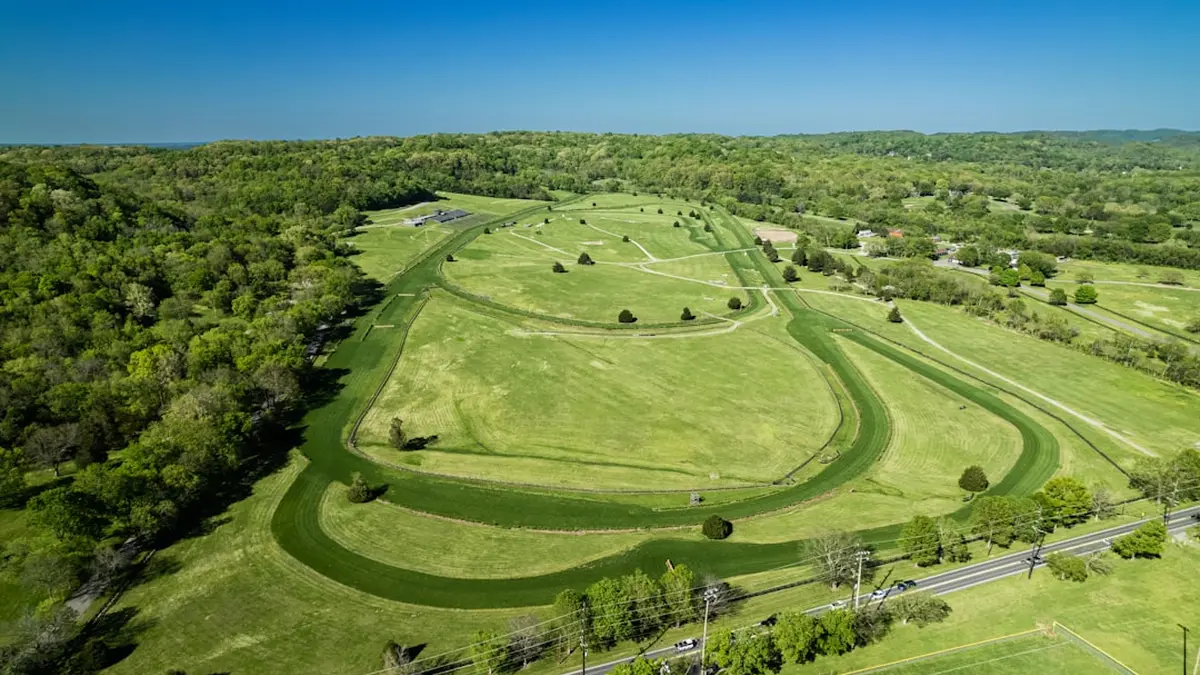
A horse that won easily at one track can look ordinary at the next one, and the horse usually has not changed. The track has. Three things about a track change how a race plays out: what it is made of (dirt, turf or a synthetic blend), how big the oval is, and how long the run to the wire is. None of this tells you who wins a given race. It tells you whether a horse is even running the kind of race it is suited to.
This page is about the surface and the shape. Spotting a bias, a track playing favorably for speed or for the rail on a given day, is a related but separate skill, covered in how to spot speed bias and track bias.
What dirt actually is
Dirt is the standard American surface, and "dirt" undersells it: every track mixes its own blend of sand, silt and clay, to its own depth, and maintains it differently depending on the weather that week. There is no single recipe, which is why past-performance lines note a horse's record on a specific track's dirt rather than on "dirt" as a category. A horse that handles one track's dirt well does not necessarily handle another's the same way, particularly on debut at a new track.
What turf asks for that dirt doesn't
Grass courses are rated by how much give they have, called the going: firm (hard and fast, the least common condition in most of the US), good, yielding (softer, with more give) and soft (wet and tiring). A turf field needs a smoother, more efficient stride to cover ground without digging in, which is partly why turf form and dirt form do not transfer cleanly in either direction, and why pedigree (some sire lines produce far more turf winners than others) is read more closely for a turf assignment than for a dirt one.
What synthetic surfaces were built to fix, and why most tracks dropped them
In 2007, California required its major tracks to install synthetic main surfaces (rubberized, wax-coated blends with trade names like Polytrack and Cushion Track), aiming to cut the injury rate. The surfaces did ride more consistently across weather than dirt, but within a decade most of them were gone: the asphalt base under Del Mar's Polytrack broke down within about seven years, trainers reported unusual soft-tissue injuries, and handicappers found the times and form on synthetic did not compare cleanly to dirt or turf form at all. Del Mar and Keeneland both removed Polytrack for new dirt surfaces between their 2014 and 2015 meets.
A few tracks kept synthetic and still run on it: Turfway Park in Kentucky and Woodbine in Ontario both race on Tapeta, a different synthetic blend, today. A horse with real synthetic-track form is worth noting the same way a turf specialist is; assuming its dirt or turf form will simply transfer to Tapeta, or the other way around, is the same mistake as assuming dirt form transfers to turf.
How a track's shape changes the same horse's chances
Beyond what the surface is made of, its size and the length of the run to the finish line change which running style has the advantage. Churchill Downs' main track is a one-mile oval; Belmont Park's is a mile and a half, with a 1,097-foot run to the wire, the longest of any Triple Crown track. A longer oval and a longer stretch both give a horse coming from off the pace more real estate to make up ground in; a tighter, shorter configuration leaves less of it, which generally favors a horse already up close early. This is one reason the same horse's running style (whether it likes to lead or likes to close) reads differently depending on where it is entered, independent of any day-to-day bias in how the track is playing.
Three ways tracks differ
| What differs | What it changes | Example |
|---|---|---|
| Surface material | Which pedigrees and running styles suit it; whether dirt or turf form transfers | Dirt vs. turf vs. Tapeta |
| Oval size | How much ground a closer can make up before the turn | Churchill Downs (1 mile) vs. Belmont Park (1 1/2 miles) |
| Stretch length | How late in the race a closer can still get there | Belmont Park's 1,097-foot stretch |
The mistakes that cost beginners money
Trusting a surface switch. A horse that won impressively on turf is not a known quantity on dirt, or on synthetic, and the reverse is just as true. A first-time surface switch is one of the least predictable spots in handicapping; treat the last race's form as weaker evidence than usual, not as equivalent.
Assuming all dirt is the same. Two "dirt" tracks can play nothing alike. Judge a horse's dirt form at the specific track it is running at today, and discount an impressive effort somewhere else until it repeats it, or something close to it, here.
Overreacting to one bad race on an unfamiliar surface. A single poor effort on turf, synthetic or an unfamiliar track does not prove a horse dislikes it; it might only prove a bad trip. Look for the pattern across more than one try before writing a horse off on a surface.
Comments
No comments yet. Be the first to comment!
Leave a Comment